
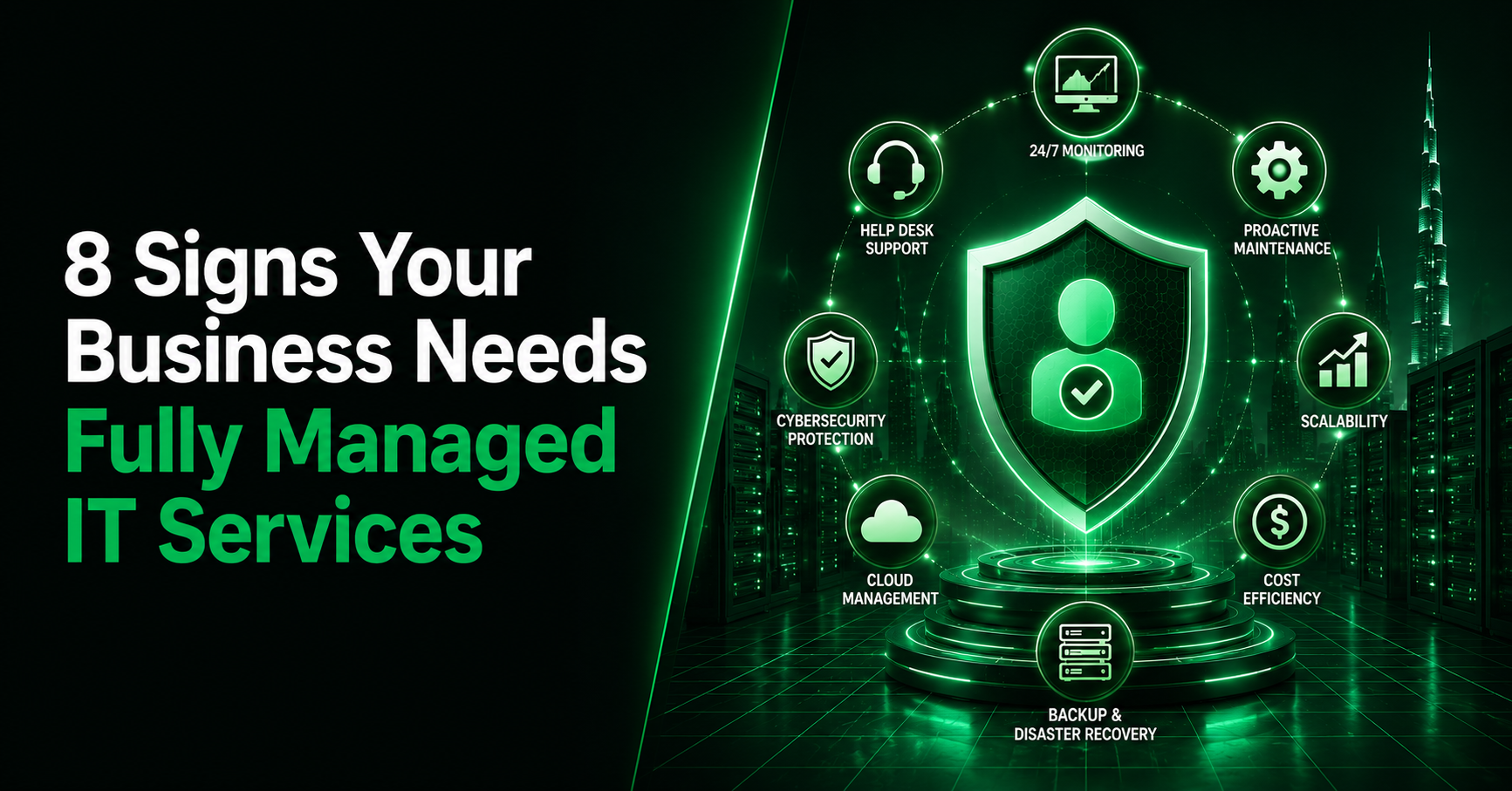
According to PwC Middle East, 86% of organizations plan to increase cloud investment over the next 12 months while 78% have already reached medium to high cloud maturity. Fully Managed IT Services help organizations across the Middle East reduce downtime, strengthen cybersecurity, optimize cloud costs, and ensure 24×7 infrastructure availability. As businesses accelerate AI adoption, cloud migration, and digital transformation, proactive IT management has become essential for maintaining performance, compliance, and business continuity. This guide explains what Managed IT Services are, the key signs your business needs them, how they compare with self-managed IT, and why enterprises across the GCC are increasingly partnering with managed service providers.
Managed IT Services are an outsourcing model where a specialized technology partner manages, monitors, secures, and optimizes your entire IT infrastructure. Instead of reacting after systems fail, managed service providers proactively monitor your environment 24×7 to prevent issues before they impact business operations.
A managed IT partner typically manages:
• Cloud infrastructure
• Physical and virtual servers
• Enterprise storage
• Network infrastructure
• Firewalls and security
• Backup and Disaster Recovery
• Database administration
• Monitoring and observability
• Patch management
• Identity and Access Management
• Compliance monitoring
• Helpdesk and technical support
The objective is simple: Your business focuses on growth while specialists manage your technology.
If your engineers spend most of their time resolving password resets, storage issues, server failures, and software updates, they have little time for strategic projects. Managed IT Services eliminate repetitive operational tasks, allowing your team to focus on innovation.
Every minute of downtime impacts:
• Revenue
• Customer experience
• Employee productivity
• Business reputation
Frequent outages often indicate inadequate monitoring, aging infrastructure, or delayed maintenance. Managed IT providers proactively monitor systems to detect and resolve issues before they become outages.
Cyber threats across the Middle East continue to evolve rapidly. The Middle East has the second-highest average cost of a data breach globally, with incidents costing organizations more than US$7 million on average. Organizations face risks such as:
• Ransomware
• Identity attacks
• Phishing campaigns
• Insider threats
• Cloud misconfigurations
• API attacks
Managed IT providers strengthen security through continuous monitoring, vulnerability management, patching, and incident response.
Many organizations migrate to the cloud expecting lower costs, only to encounter:
• Idle virtual machines
• Oversized compute resources
• Unused storage
• Poor workload optimization
• Unexpected monthly bills
Managed cloud services continuously optimize resource utilization to improve performance and control costs.
Many industries across the Middle East operate under increasingly stringent regulatory frameworks, including:
• UAE Information Assurance
• Saudi ECC Framework
• Qatar National Information Assurance Framework
• ISO 27001
• PCI DSS
• GDPR
• Industry-specific cybersecurity regulations
Maintaining compliance manually is both expensive and time-consuming. Managed IT Services help ensure continuous compliance through monitoring, reporting, patching, and governance.
According to PwC Middle East, 78% of organizations already use cloud-based AI and machine learning capabilities, increasing the need for scalable and resilient infrastructure. Business growth often creates infrastructure challenges such as:
• Opening new offices
• Expanding across GCC countries
• Deploying AI applications
• Launching digital services
• Supporting seasonal demand
Scaling internally requires additional hiring, procurement, and implementation. Managed IT Services enable rapid infrastructure expansion without increasing operational complexity.
Many organizations have backups, but few regularly test whether they can actually restore operations. Managed service providers continuously validate:
• Backup integrity
• Disaster recovery readiness
• High availability
• Recovery objectives (RPO/RTO)
Because backups only matter when recovery succeeds.
Finding experienced infrastructure engineers, cloud architects, cybersecurity specialists, and database administrators has become increasingly difficult. Managed IT Services provide access to specialized expertise without the need to build every capability in-house.
A comprehensive Managed IT provider delivers end-to-end technology operations, including:
| Self-Managed IT | Fully Managed IT Services |
| Reactive maintenance | Proactive monitoring |
| Internal hiring required | Access to certified specialists |
| Limited business hours | 24×7×365 operations |
| Higher operational overhead | Predictable monthly cost |
| Manual security management | Continuous security monitoring |
| Infrastructure managed separately | End-to-end unified management |
| Scaling requires hiring | Rapid on-demand scalability |
| Greater operational risk | SLA-backed service delivery |
To meet national digital mandates and bridge talent gaps in AI and cloud, Middle Eastern firms are shifting to managed IT services. Driven by cybersecurity needs and efficiency, this adoption is fueling rapid growth; the IMARC Group projects the market to reach USD 81.5 billion by 2034 at a 13.66% CAGR.
The impact of unmanaged infrastructure often appears gradually rather than all at once. Organizations commonly face:
Global Infra delivers enterprise-grade managed IT services designed for modern businesses operating across the Middle East.
Key capabilities of GlobalInfra include:
With a global delivery model and enterprise infrastructure expertise, Global Infra helps organizations reduce operational complexity while improving performance, resilience, and security.
Reduce downtime, improve security, optimize cloud costs, and give your internal IT team the freedom to focus on innovation instead of day-to-day maintenance.