
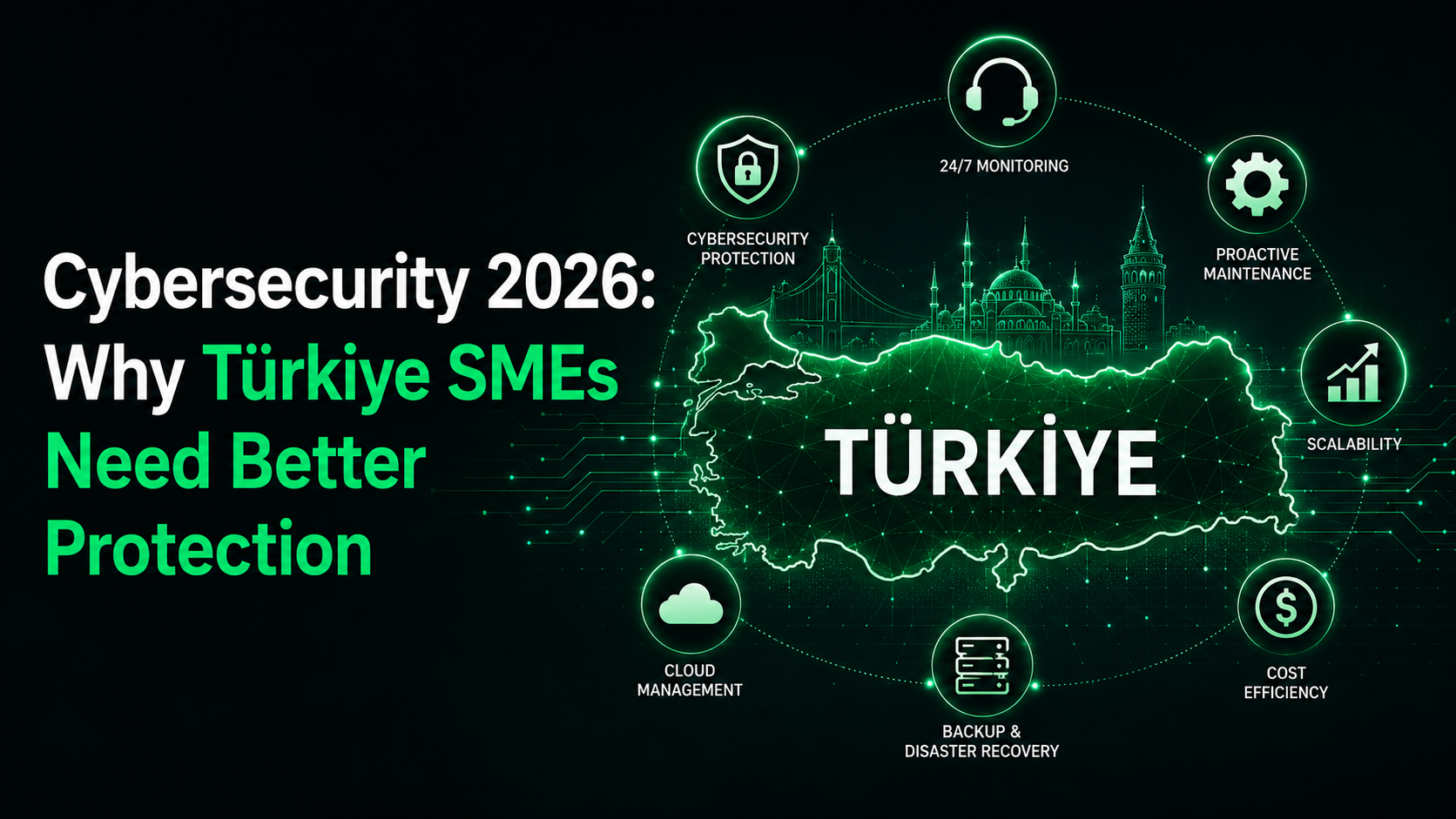
Turkish SMEs face growing cyber security risks in 2026, particularly from ransomware, phishing, credential theft, data breaches and attacks on cloud-connected systems. The main reason is not simply a lack of security tools. Many small and medium-sized businesses have limited security teams, fragmented IT environments, weak identity controls and inadequate backup or incident-response processes. For businesses handling personal data, the risk is also regulatory: Türkiye’s Personal Data Protection Law (KVKK) requires organisations to take appropriate technical and organisational measures to protect personal data. For Turkish SMEs, cyber security is therefore both a business continuity and compliance issue.
Turkish SMEs are becoming more digital. But is security keeping pace?
The risk is not simply that Turkish SMEs are vulnerable. It is that Türkiye connects too many valuable systems, markets and supply chains to be treated as an ordinary SME market.
Consider the geography of the opportunity:
A Turkish SME may not be globally significant on its own. But it may sit inside a globally significant supply chain.
Europe → Türkiye → Middle East
The EU–Türkiye Customs Union has embedded Turkish manufacturers and exporters into European industrial value chains. Automotive, machinery, electrical equipment and other manufacturing businesses routinely operate across borders.
Türkiye → Africa
Turkish companies are increasingly active across African infrastructure, construction, logistics, energy, healthcare and manufacturing markets. Bilateral trade with Africa has grown dramatically over two decades.
Türkiye → Pakistan and South Asia
The relationship extends beyond trade. Turkish companies have invested around $2 billion in Pakistan and Turkish contractors have undertaken projects worth approximately $3.5 billion there. Around 420 Pakistani companies operate in Türkiye.
This creates interconnected access. A compromised Turkish supplier can potentially expose credentials, communications, commercial data or access pathways across Europe, the Middle East, Africa and South Asia.
Türkiye has already seen attacks involving organisations with substantial digital footprints.
These attacks show that Turkish networks, identities and infrastructure are already valuable targets. SMEs operate within the same ecosystem, often with fewer resources to detect and contain an intrusion.
Türkiye has responded by strengthening its cyber security framework. The country’s Cyber security Directorate was established under the 2025 Cyber security Law, with responsibility for strengthening cyber resilience and digital security.
For businesses, regulation does not remove the operational risk: an undetected breach can become a prolonged outage, a data-protection incident and a supply-chain problem simultaneously.
The pressure on Turkish SMEs is therefore coming from four directions:
For a Turkish SME, one compromised account or endpoint can disrupt sales, logistics, production, payments and customer operations, with consequences that can extend across connected supply chains.
That is where cyber security becomes a business continuity issue.
Master card reported that 46% of surveyed small businesses had experienced a cyber attack, with nearly one in five affected businesses subsequently filing for bankruptcy or closing.
01 — Know your attack surface
Map endpoints, cloud workloads, applications, identities, sensitive data and third-party connections.
02 — Protect identities
Implement MFA, privileged-access controls and regular access reviews. A stolen credential should not become a company-wide breach.
03 — Detect continuously
Centralise logs and security alerts so suspicious activity is identified before it becomes an operational crisis.
04 — Design for recovery
Maintain isolated, tested backups and define which systems must be restored first.
05 — Have a response plan
Know who investigates, who contains the attack, who handles customers and regulators and who restores operations.
The goal is simple: reduce the time between compromise, detection and recovery.
The objective is not to build a business that can never be attacked. It is to build one that can detect faster, contain the damage and keep operating. For Turkish SMEs, cyber security in 2026 should be treated as three things at once:
Cyber security → Protect the business.
Compliance → Protect the data.
Resilience → Protect the ability to operate.
The question is no longer whether a Turkish SME is important enough to be attacked.
It is whether the business is prepared for what happens after the attacker gets in.
Global Infra Holding helps Turkish businesses build secure, resilient infrastructure for critical workloads, from protection and monitoring to backup, recovery and business continuity.
Protect your infrastructure. Strengthen your resilience. Stay operational.