
AI infrastructure is changing quickly. As models become larger, inference workloads become more demanding, and enterprises move from experimentation to production AI, GPU selection is becoming an infrastructure decision rather than simply a hardware decision.
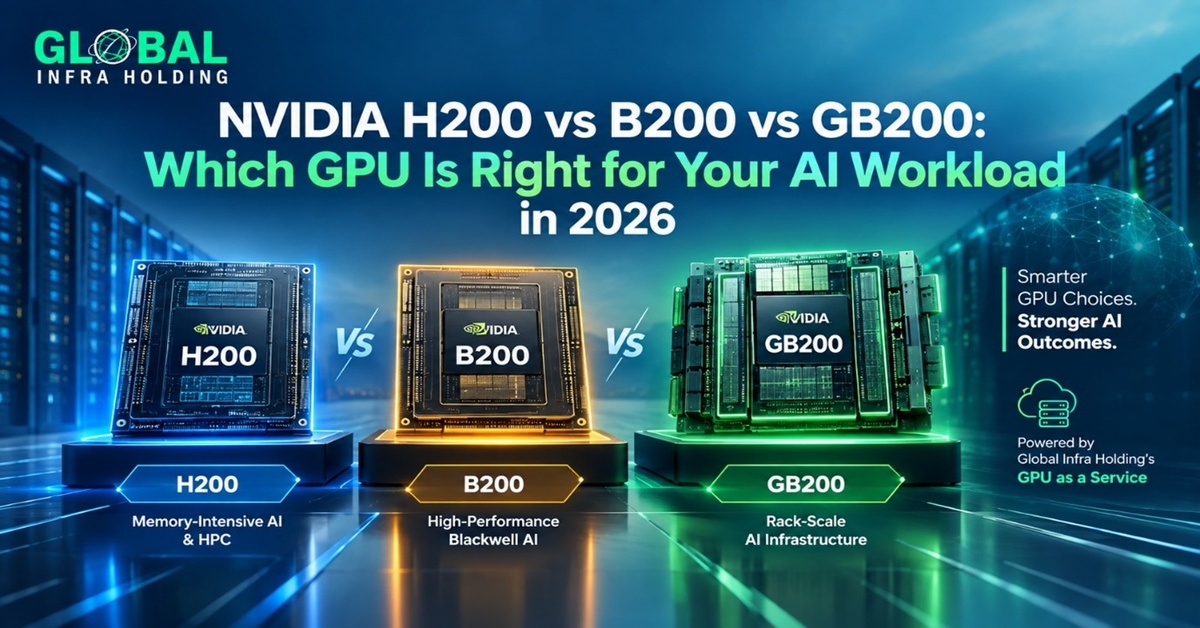
NVIDIA’s H200, B200 and GB200 platforms address different levels of AI computing. The H200 is built on the Hopper architecture and focuses heavily on memory-intensive AI and HPC workloads. The B200 moves to the Blackwell architecture with substantially higher memory bandwidth and capacity. GB200 takes the architecture further by combining Grace CPUs and Blackwell GPUs into a tightly connected, rack-scale platform for large AI workloads.
So, which one should enterprises choose in 2026?
The answer depends on what you are running, how large your models are, how much you need to scale, and whether you are optimising for training, inference or both.
| Factor | NVIDIA H200 | NVIDIA B200 | NVIDIA GB200 |
| Architecture | Hopper | Blackwell | Grace Blackwell |
| GPU memory | 141 GB HBM3e | 180 GB HBM3e | 372 GB HBM3e per GB200 superchip* |
| Memory bandwidth | 4.8 TB/s | Up to 8 TB/s | Up to 16 TB/s per superchip* |
| Typical scale | GPU / multi GPU servers | GPU / multi GPU AI systems | Rack scale |
| Key strength | Large memory + AI/HPC | High performance AI training and inference | Large scale AI and reasoning |
| Best suited for | LLM inference, RAG, HPC | Training, inference, enterprise AI | Large models, advanced inference, AI factories |
The NVIDIA H200 remains highly relevant in 2026 for organisations that need substantial GPU memory without moving immediately to a Blackwell-based platform.
The H200 features 141 GB of HBM3e memory and 4.8 TB/s of memory bandwidth. NVIDIA positions it for generative AI, large language models and HPC workloads.
This makes H200 particularly relevant for:
⦁ Large language model inference
⦁ Retrieval-augmented generation
⦁ AI development and experimentation
⦁ Computer vision
⦁ Speech AI
⦁ Scientific computing
⦁ HPC workloads
For enterprises already operating Hopper-based infrastructure, H200 can also provide a practical path for increasing memory capacity and bandwidth without completely changing the underlying generation of infrastructure.
The B200 represents NVIDIA’s transition from Hopper to the Blackwell architecture.
A B200 GPU provides 180 GB of HBM3e memory and up to 8 TB/s of memory bandwidth, according to NVIDIA’s HGX platform documentation.
Compared with H200, the difference is not simply about having a newer GPU. The higher memory bandwidth and Blackwell architecture are particularly relevant for workloads where model size, throughput and computational intensity are increasing.
B200 can be considered for:
⦁ Large model training
⦁ Generative AI
⦁ High-throughput inference
⦁ Enterprise AI applications
⦁ AI model fine-tuning
⦁ Large-scale experimentation
NVIDIA’s DGX B200 platform combines eight B200 GPUs, providing 1,440 GB of total GPU memory and 64 TB/s of aggregate HBM3e bandwidth.
GB200 changes the conversation from individual GPUs to integrated AI infrastructure.
A GB200 Grace Blackwell Superchip combines one Grace CPU with two Blackwell GPUs, connected through NVIDIA’s NVLink-C2C architecture. NVIDIA lists up to 372 GB of HBM3e GPU memory and 16 TB/s of memory bandwidth for the superchip configuration.
At the rack level, the GB200 NVL72 integrates:
⦁ 36 Grace CPUs
⦁ 72 Blackwell GPUs
⦁ 13.4 TB of HBM3e
⦁ 576 TB/s of aggregate memory bandwidth
⦁ 130 TB/s of NVLink bandwidth
This architecture is aimed at extremely large AI workloads, including large-scale model training and demanding inference and reasoning workloads.
This is where the decision becomes more practical.
⦁ For AI training
Training large models requires massive computational throughput, high memory bandwidth and fast communication between GPUs.
B200 and GB200 become particularly relevant as model sizes and training requirements increase. GB200’s rack-scale NVLink architecture is designed for workloads where communication between large numbers of GPUs becomes a critical part of the infrastructure.
⦁ For AI inference
Inference requirements can vary significantly.
For RAG, enterprise copilots, recommendation engines or computer vision, H200 may provide the required memory and performance without requiring a rack-scale architecture.
For extremely large models and advanced reasoning workloads, Blackwell-based systems such as B200 and GB200 can provide a different level of scale.
The GPU decision is only one part of the infrastructure equation.
Enterprises also need to consider:
⦁ GPU availability
⦁ Infrastructure investment
⦁ Power and cooling
⦁ Networking
⦁ Storage
⦁ Cluster management
⦁ Scaling requirements
⦁ Utilisation
⦁ AI workload duration
⦁ Infrastructure refresh cycles
This is where GPU as a Service becomes an alternative to purchasing and operating GPU infrastructure directly.
Instead of making a large upfront infrastructure commitment, organisations can access GPU compute based on their workload requirements.
Global Infra Holding GPU as a Service
For businesses experimenting with AI, running variable workloads or scaling AI applications gradually, this approach can allow infrastructure capacity to follow demand.
Rather than asking “Which NVIDIA GPU is the most powerful?”, enterprises should ask:
“Which GPU architecture matches my workload?”
| Your requirement | Platform to evaluate |
| Memory-heavy AI and HPC | H200 |
| High-performance Blackwell training | B200 |
| Large-scale AI infrastructure | GB200 |
| Variable or project-based GPU demand | GPU as a Service |
| Rapid AI experimentation | GPU as a Service |
| Large-scale production AI | B200 / GB200 depending on workload |
For organisations that don’t want to build an AI infrastructure stack from the ground up, Global Infra Holding’s GPU as a Service can be positioned as the bridge between GPU demand and infrastructure availability.
The proposition can be kept simple:
Access GPU infrastructure when you need it. Scale when your workload grows. Avoid building your entire GPU infrastructure stack upfront.
That makes GPUaaS relevant not only for AI startups, but also for enterprises experimenting with GenAI, model development, inference, fine-tuning and other GPU-intensive workloads.
H200 continues to address memory-intensive AI and HPC workloads. B200 brings Blackwell architecture to demanding training and inference environments. GB200 takes the concept further into tightly integrated, rack-scale AI infrastructure.
But the right choice isn’t necessarily the newest or most powerful platform.
It is the platform that aligns with your model size, workload type, performance requirements, scale and infrastructure strategy.
And when GPU requirements are difficult to predict, GPU as a Service can provide another path: access the compute you need without making GPU infrastructure ownership the starting point.
Not sure which GPU infrastructure fits your AI workload?
Explore GPU as a Service from Global Infra Holding and build your AI compute strategy around your actual workload requirements.
Explore Global Infra Holding GPU as a Service