
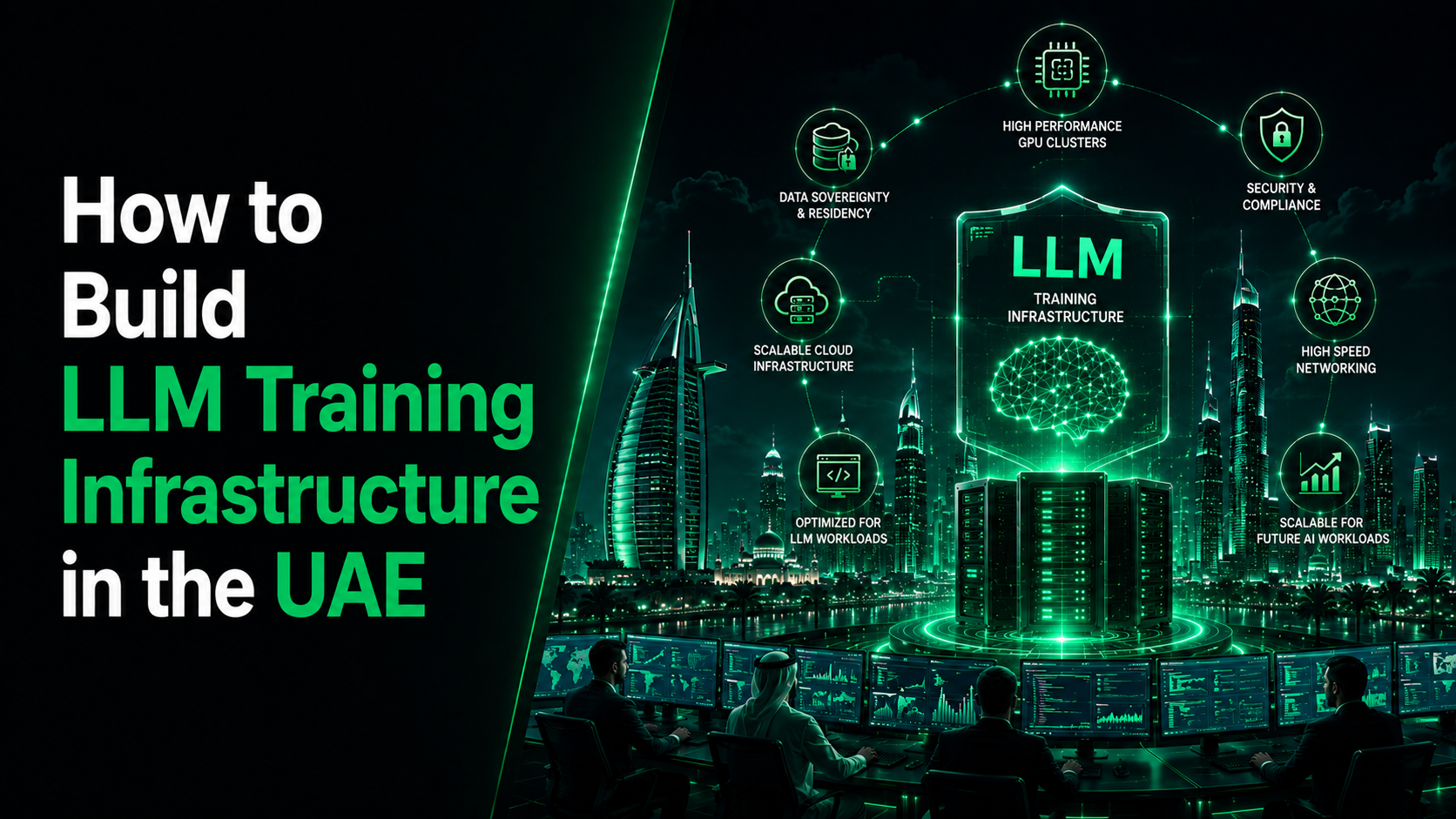
If you’re planning to train a Large Language Model (LLM) in the UAE, you’ll need much more than GPUs. Modern LLM training infrastructure includes accelerated compute, high-bandwidth networking, parallel storage, distributed AI frameworks, workload orchestration, data engineering pipelines and enterprise security. Sovereign AI infrastructure with UAE data residency is often a core requirement alongside performance, scalability and cost efficiency in government and enterprises.
A production-ready AI infrastructure combines multiple technology layers that work together throughout the training lifecycle.
A typical LLM infrastructure consists of:
Every layer directly impacts training speed, scalability and operational cost.
Training modern language models involves processing billions or even trillions of parameters across enormous datasets. Without optimized infrastructure, organizations face:
A well-designed AI platform ensures compute, storage and networking operate together as a unified environment rather than isolated components.
1. GPU Compute Clusters
GPUs perform the mathematical operations required to train deep learning models at scale. Modern LLM training distributes workloads across hundreds or even thousands of GPUs working simultaneously.
Key considerations include:
2. High-Speed Networking
During distributed training, GPUs constantly exchange model parameters. Slow networking quickly becomes the biggest performance bottleneck.
Essential networking capabilities are:
3. High-Performance Storage
Large language models consume petabytes of training data. Storage must deliver data fast enough to keep GPUs continuously utilized.
Storage requirements include:
4. AI Software Stack
Hardware alone cannot train an LLM. Organizations also require optimized AI frameworks and orchestration platforms.
Typical software components include:
5. Data Pipeline
The quality of an LLM depends heavily on the quality of its training data.
An effective data pipeline supports:
6. Monitoring and Resource Management
AI infrastructure requires continuous visibility into GPU utilization, memory usage, storage throughput and training performance.
Monitoring capabilities include:
Many UAE organizations operate under strict data residency, privacy and regulatory requirements. Training sensitive AI models on external infrastructure may introduce compliance, governance and intellectual property concerns.
A sovereign AI platform enables organizations to:
For industries such as government, healthcare, finance and energy, sovereign AI infrastructure is becoming a strategic requirement rather than simply an operational choice.
1. Faster Model Training
Optimized compute, storage and networking reduce training times, allowing models to move from experimentation to production more quickly.
Benefits include:
2. Lower Infrastructure Costs
Efficient resource management minimizes wasted compute capacity and improves return on expensive GPU investments.
Cost optimization includes:
3. Better Model Performance
Reliable infrastructure enables larger datasets, more stable distributed training and improved experimentation, resulting in higher-quality models.
4. Stronger Security and Compliance
AI infrastructure designed with governance in mind helps organizations secure training data, control access and maintain compliance throughout the AI lifecycle.
| Capability | Traditional Infrastructure | AI-Ready Infrastructure |
| Compute | General-purpose servers | GPU-accelerated clusters |
| Networking | Standard Ethernet | Low-latency, high-bandwidth fabric |
| Storage | General enterprise storage | High-performance parallel storage |
| Scalability | Limited | Distributed AI scaling |
| Resource Management | Manual provisioning | Automated orchestration |
| AI Optimization | Minimal | Purpose-built for deep learning |
Organizations planning to train their own language models should focus on:
The right AI infrastructure can dramatically reduce training time, improve GPU utilization and provide the scalability needed for next-generation language models. Whether you’re building sovereign AI capabilities, developing domain-specific LLMs or expanding enterprise AI initiatives, a purpose-built infrastructure forms the foundation for long-term success.