
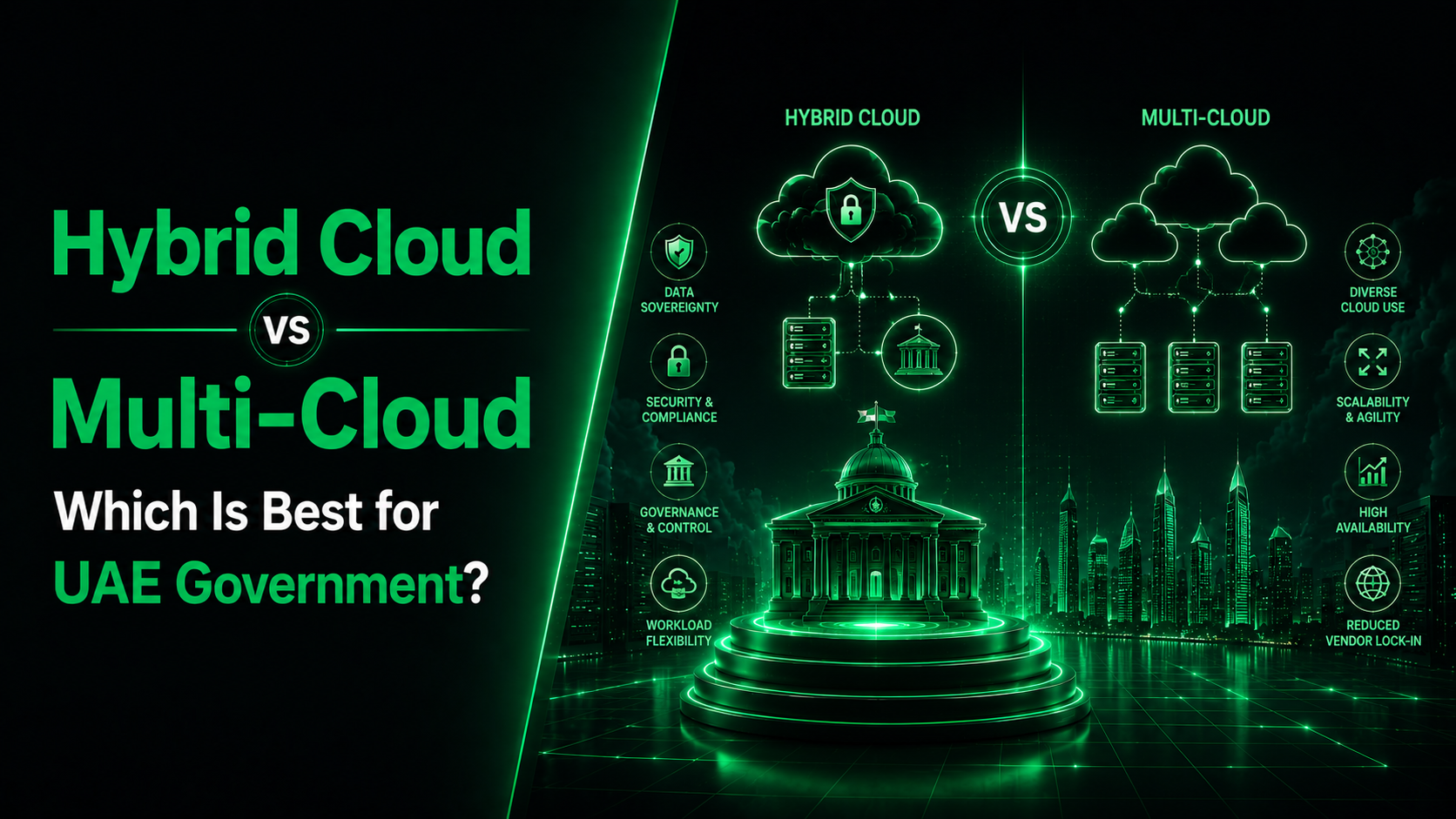
Which wins, multi-cloud or hybrid cloud, for UAE government agencies? In most cases, hybrid cloud architecture wins for regulated and mission-critical workloads, while multi-cloud architecture works better for non-sensitive, high-elasticity services. The right government cloud strategy isn’t about picking one model outright, it’s about matching architecture to data classification, with sovereign cloud and data sovereignty requirements deciding where each workload sits.
Multi-cloud architecture means running workloads across more than one public cloud providers, often to access best-of-breed services or avoid vendor lock-in. For UAE government agencies, it suits non-sensitive, public-facing workloads where flexibility matters more than strict data residency requirements.
Hybrid cloud architecture combines a private cloud environment, typically hosted within UAE borders, with public cloud resources for less sensitive or more elastic needs. This model keeps sensitive citizen data and mission-critical applications inside a controlled, sovereign cloud environment while still allowing scalable components to run on public infrastructure.
UAE government agencies must align cloud infrastructure choices with the UAE Cloud First policy, the UAE Digital Government Strategy 2025, Dubai Smart City initiatives, TDRA regulations and the UAE Personal Data Protection Law (PDPL). Together, these frameworks make data sovereignty and regulatory compliance non-negotiable design constraints, not afterthoughts.
No. The UAE Cloud First policy pushed public sector organizations toward cloud adoption strategy by default, but it never meant unregulated cloud use. Agencies handling sensitive citizen data, such as Emirates ID records or healthcare files, still need architecture that satisfies data residency requirements under PDPL and TDRA regulations.
Multi-cloud architecture fits government workloads that are non-sensitive and need elasticity, such as public information portals, internal collaboration tools or dev and test environments. Here, avoiding vendor lock-in and optimizing cost outweigh strict data residency requirements.
Hybrid cloud architecture fits government workloads tied to regulated or sensitive citizen data, national security or mission-critical applications. Anchoring these in a sovereign cloud environment satisfies data residency requirements while still allowing non-sensitive components to scale on public cloud infrastructure.
Disaster recovery tends to be more predictable under hybrid cloud architecture because core systems of record stay within a controlled sovereign environment. Cloud-based DR sites can then add redundancy and operational resilience without moving core data outside sovereign boundaries.
The smartest government cloud strategies separate workloads by data classification, not by picking one architecture for everything.
If you’re deciding between multi-cloud and hybrid cloud architecture, ask yourself:
If you answered “yes” to most of these for a given workload, hybrid cloud architecture anchored in sovereign infrastructure is likely the safer fit.
The question is no longer whether UAE government agencies need cloud infrastructure. Most already do. The challenge is building cloud governance that segments workloads by sensitivity, applying hybrid cloud architecture where data sovereignty matters most and multi-cloud architecture where flexibility matters more. For many public sector organizations, this segmented approach makes regulatory compliance easier to prove than any single uniform deployment ever could.
Global Infra Holdings is a Middle East-focused cloud infrastructure brand built to be compliant-by-design rather than compliant-by-retrofit. Data residency, sovereign cloud architecture and alignment with regional frameworks like TDRA regulations and PDPL are foundational from day one.
For UAE government agencies navigating multi-cloud vs hybrid cloud decisions, GIH offers a hybrid-first sovereign cloud foundation, keeping regulated workloads within UAE jurisdiction while still enabling multi-cloud flexibility for less sensitive operations.
No, not if it’s planned by workload rather than applied uniformly. Non-sensitive, fast-moving projects can still run on multi-cloud or public cloud infrastructure. Only the regulated portion needs to sit inside a sovereign cloud environment, so transformation speed isn’t sacrificed across the board.
Ask whether it touches citizen records, national security data or anything covered under the UAE Personal Data Protection Law (PDPL) and TDRA regulations. If yes, it needs a sovereign cloud environment. If the data is public-facing or non-sensitive, it doesn’t.
Mismatched architecture, sensitive data sitting in standard public cloud infrastructure, is one of the most common compliance failures during audits. Getting data residency requirements wrong isn’t just inefficient, it creates direct regulatory exposure under PDPL and TDRA regulations.
Not necessarily. Vendor lock-in is a multi-cloud architecture concern more than a hybrid one. A well-designed hybrid cloud architecture can still use multiple providers for its public cloud component while keeping the sovereign, private layer separately controlled.
Yes, but it’s easier to design for this upfront than to retrofit later. Ask any potential provider directly whether their architecture supports moving regulated workloads into a sovereign cloud environment without a full platform rebuild.
Multi-cloud architecture can lower costs for elastic, non-sensitive workloads through competitive pricing across public cloud providers. Hybrid cloud architecture often costs more upfront for the sovereign component, but reduces compliance risk and audit costs, which matters more for regulated public sector organizations.
Responsibility is shared, but accountability under PDPL and TDRA regulations rests with the government agency. This is why it matters to choose a provider that is compliant-by-design, like GIH, rather than one that treats UAE data protection regulations as an add-on feature.
Ask whether they support workload segmentation, whether sensitive data stays verifiably within UAE jurisdiction, how disaster recovery works without moving regulated data outside sovereign boundaries and whether their compliance posture was built from the start or added later to meet demand.
Get a Compliance-Ready Cloud Assessment
From data residency to disaster recovery, find out which workloads belong in a sovereign cloud environment and which don’t.