
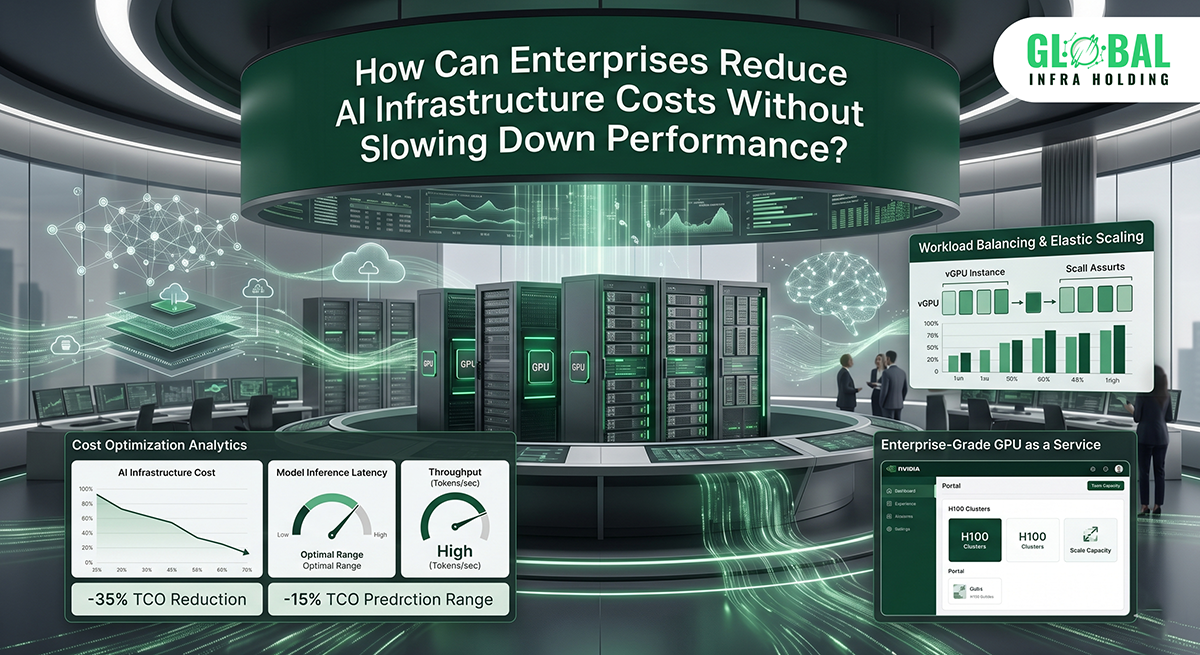
AI adoption across enterprises is accelerating, but the friction rarely comes from models or algorithms. It shows up in infrastructure quietly and consistently. A training job runs longer than expected, inference costs rise with usage and GPU bills increase without a clear explanation. What begins as experimentation quickly turns into a cost management challenge.
For CTOs and technology leaders, the question is no longer whether AI works. It’s whether it can scale without turning infrastructure into an unpredictable expense. The common assumption is that reducing cost will affect performance. In reality, that trade-off often comes from how infrastructure is designed not from AI itself.
AI workloads behave very differently once they move beyond experimentation. Training large models requires sustained compute, high memory bandwidth and efficient data flow. Even small inefficiencies begin to compound over time.
In many enterprise environments, similar patterns appear. GPUs remain allocated but underutilized. Clusters are over-provisioned to avoid delays. Workloads queue due to limited availability, while data pipelines slow down compute cycles. According to insights from McKinsey & Company, inefficient infrastructure usage can increase costs by 20–30% in data-heavy environments.
This highlights a critical point: rising costs are not always driven by demand they are often driven by inefficiency.
Reducing AI infrastructure cost is often misunderstood. Cutting resources may seem like the simplest solution, but it typically leads to longer training cycles and slower outputs. Instead, the focus needs to shift toward optimization.
This is where GPU as a Service becomes relevant. By enabling on-demand GPU access, enterprises can scale infrastructure based on actual workload requirements rather than fixed assumptions. This reduces idle capacity and improves cost control, particularly for GPU cloud workloads that fluctuate in intensity.
The shift is subtle but important. It moves the conversation from spending less to using infrastructure more efficiently.
Not every AI workload requires the same level of compute, yet many organizations continue to use a uniform infrastructure approach. This leads to over-provisioning in some areas and inefficiency in others.
In enterprise AI GPU environments, segmentation becomes essential. High-performance clusters should be reserved for training, while inference workloads can run on optimized configurations. Experimental workloads require flexibility rather than scale.
Gartner has observed that organizations aligning infrastructure with workload needs improve both utilization and operational efficiency. Right-sizing compute ensures that performance is maintained while unnecessary costs are avoided.
Access to GPUs is no longer the primary challenge. Efficient utilization is. In many enterprise setups, GPUs operate below capacity due to poor scheduling, data bottlenecks, or fragmented orchestration.
This becomes more complex in GPU cloud workloads, where distributed systems require careful coordination. Idle cycles and inefficient job allocation directly impact cost.
Improving utilization does not require additional infrastructure. It requires better orchestration, smarter scheduling, and alignment between data pipelines and compute resources. Even marginal improvements can result in noticeable cost savings at scale.
Compute often receives the most attention, but storage and data movement play an equally important role in AI infrastructure cost. AI workloads depend on continuous data access, high-speed transfers, and large-scale storage systems.
When storage performance does not match GPU throughput, bottlenecks occur. Data takes longer to reach compute nodes, slowing down training and increasing runtime. This creates a direct impact on cost.
Optimizing data pipelines, reducing unnecessary data movement, and aligning storage with compute performance can significantly improve both efficiency and execution speed.
To avoid delays, many enterprises allocate more resources than necessary. While this ensures availability, it results in unused capacity and higher costs.
Elastic scaling offers a more efficient alternative. Instead of provisioning for peak demand, infrastructure scales dynamically based on workload requirements. Training workloads scale during execution, inference adjusts to real-time usage, and idle resources are released automatically.
This approach ensures that enterprises pay for actual usage rather than anticipated demand. It also allows teams to maintain performance without committing to excess capacity.
Fragmentation across infrastructure layers often leads to inefficiencies that are difficult to detect. When compute, monitoring, orchestration, and security operate in silos, visibility becomes limited.
An integrated approach brings these elements together, enabling real-time monitoring, centralized orchestration, and clear cost tracking. This reduces operational overhead and helps identify areas where resources are being underutilized.
This is where infrastructure approaches, such as those adopted by Global Infra Holding, begin to align with enterprise requirements—combining GPU compute, cloud environments, and operational intelligence into a unified ecosystem that supports both performance and control.
There is no single solution to reducing AI infrastructure cost. Instead, enterprises that succeed in this area follow a consistent pattern.
They align compute resources with workload requirements. They improve GPU utilization and optimize data pipelines. They adopt elastic scaling strategies instead of fixed provisioning. And they move toward integrated infrastructure environments that provide better visibility and control.
These changes, when implemented together, create a system that is both efficient and scalable.
AI is no longer confined to experimentation. It is becoming central to business operations, which means infrastructure decisions carry long-term implications.
Reducing cost is not about limiting performance. It is about designing systems that operate efficiently without wasting resources. When infrastructure is aligned with workload needs, performance and cost no longer compete—they complement each other.
The question is no longer how much AI infrastructure costs. The real question is how efficiently it runs. And increasingly, that depends on how intelligently it is built from the start.