
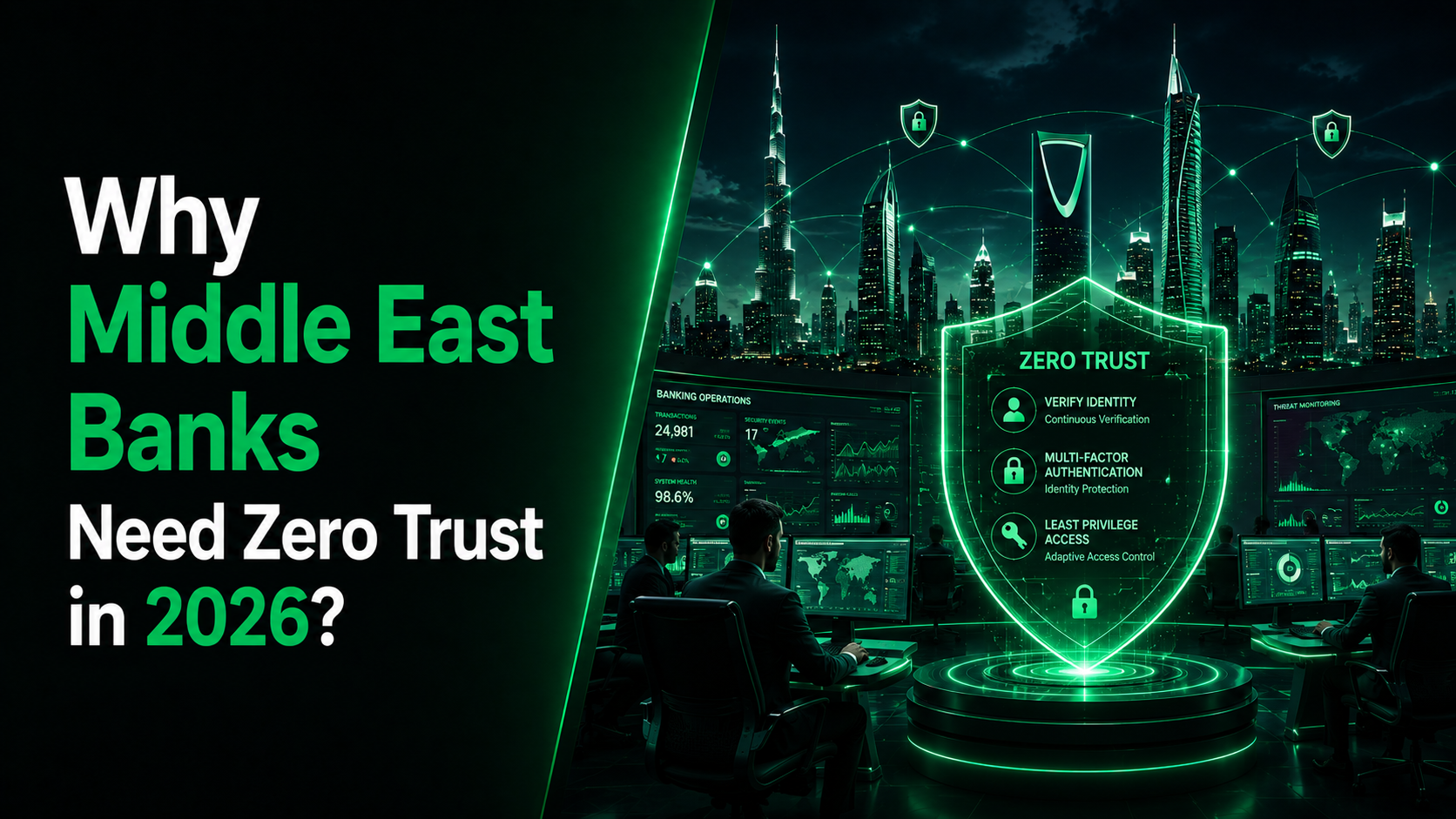
The question is no longer whether Middle East financial institutions need Zero Trust security, but how quickly they can implement it. As banking becomes increasingly cloud-first, Zero Trust Architecture is moving from a cybersecurity best practice to a business necessity.
Zero Trust Architecture (ZTA) is a cybersecurity framework that verifies every user, device, application and network connection before granting access. Instead of relying on network location, it makes identity the primary security control.
A mature Zero Trust strategy typically includes:
The biggest cybersecurity risk for financial institutions is no longer hackers breaking through the firewall. It is legitimate users, compromised credentials and third-party applications that already have access to the network.
Modern banks now operate across:
Zero Trust stops this lateral movement by validating every request and limiting users to only the resources they need.
1. Increasing Sophistication of Cyberattacks
Financial institutions remain prime targets for ransomware, phishing, credential theft and supply chain attacks because they manage sensitive customer data and high-value transactions. Zero Trust minimizes this risk by verifying every user and restricting access at every stage.
Common attack vectors:
2. Expanding Digital Banking Services
Mobile banking, instant payments, AI-powered financial services and digital onboarding have dramatically increased the number of applications and APIs banks must secure. Every new digital service creates another potential entry point, making continuous identity verification essential rather than optional.
Digital channels driving Zero Trust adoption:
3. Stronger Regulatory Expectations
Financial regulators across the Middle East increasingly expect organizations to demonstrate continuous cybersecurity instead of periodic compliance audits.
Key focus areas include:
4. Growth of Hybrid and Multi-Cloud Environments
Banks now operate across private clouds, public clouds, SaaS platforms and regional data centers, making traditional network boundaries less relevant.
Modern banking infrastructure typically includes:
| Sr. No | Component | Purpose |
| 1 | Identity Verification | Authenticate every user continuously |
| 2 | Multi-Factor Authentication | Reduce credential-based attacks |
| 3 | Least Privilege Access | Limit unnecessary permissions |
| 4 | Micro-Segmentation | Prevent lateral movement |
| 5 | Device Trust Validation | Verify endpoint security posture |
| 6 | Continuous Monitoring | Detect anomalies in real time |
| 7 | Security Analytics | Identify suspicious behavior quickly |
Reduced Risk of Data Breaches
Zero Trust limits the impact of cyberattacks by continuously verifying user identities and enforcing least-privilege access. Even if an account is compromised, attackers cannot move freely across the network, reducing the risk of credential theft, insider threats and large-scale data breaches.
Faster Threat Detection
Continuous monitoring helps security teams identify suspicious activity before it escalates into a major incident.
Examples include:
Improved Customer Trust
Strong identity verification and access controls help protect customer accounts and strengthen confidence in digital banking services.
Simplified Compliance
Zero Trust continuously records authentication events and access activity, making regulatory reporting simpler while supporting an always-on compliance posture.
| Capability | Traditional Security | Zero Trust |
| Network Trust | Trust internal users | Verify every request |
| Authentication | Login once | Continuous validation |
| User Permissions | Broad access | Least privilege |
| Threat Detection | Reactive | Continuous monitoring |
| Lateral Movement Protection | Limited | Micro-segmentation |
| Hybrid Cloud Security | Complex | Built into the model |
Organizations should focus on:
Ready to Modernize Your Financial Security Strategy?
A Zero Trust assessment can uncover identity risks, excessive user privileges, network exposure and compliance gaps before they become security incidents, helping your organization build a resilient, compliance-ready security posture.