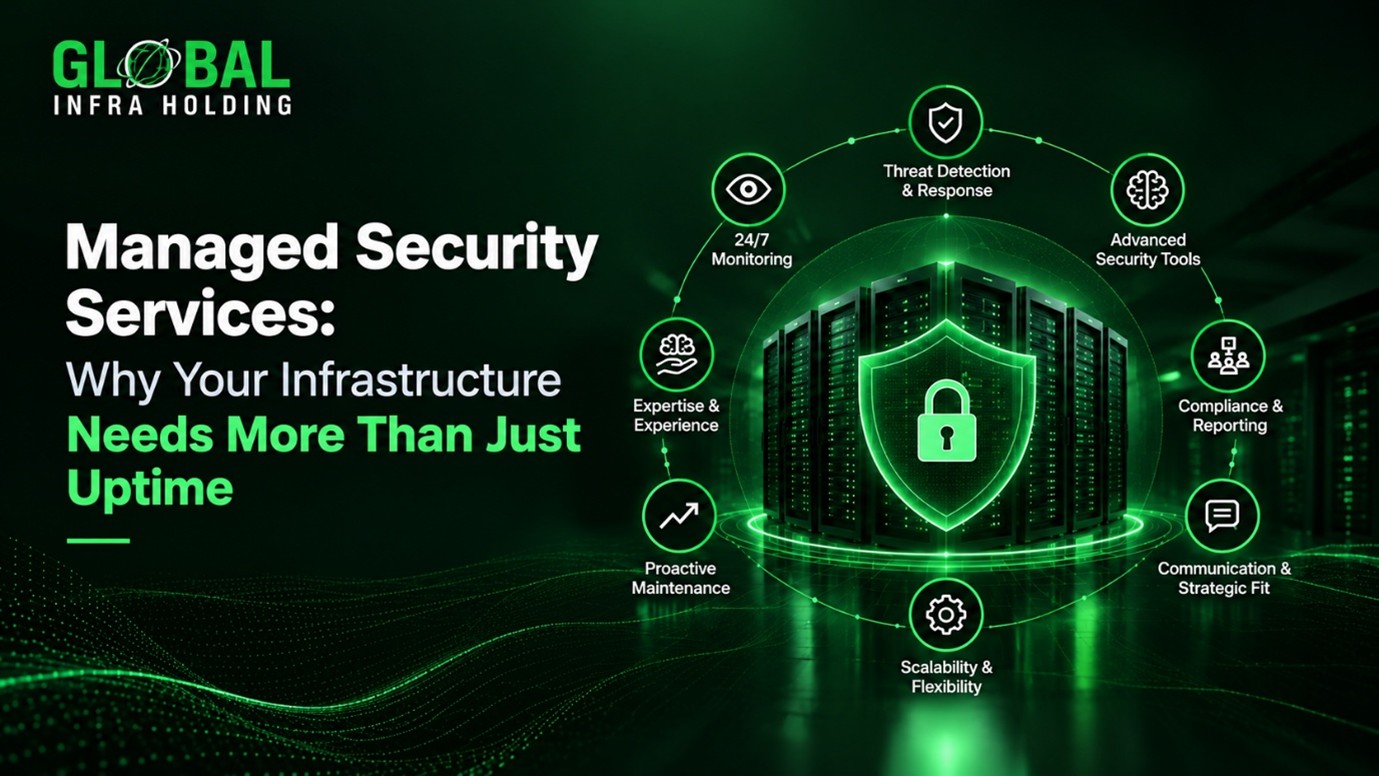
Managed Security Services: Why Your Infrastructure Needs More Than Just Up time
  • Admin-global-infra
  • Comments 0
  • 07 Sep 2026

Infrastructure can be scaling well, deployment cycles running fast, and workloads expanding, right up until a client requests proof of security controls ahead of a contract renewal, or a routine audit flags a gap nobody owned. IT points to the cloud provider, the provider points back to internal policy, and no one can produce audit-ready evidence on short notice. The result is a stalled deal, or worse, an exposure that goes unnoticed until it becomes an incident.
This is the reality driving more businesses toward Managed Security Services (MSS): a way to keep security operations running continuously without stretching an already lean IT team thinner.

What Are Managed Security Services?

Managed Security Services refer to the outsourced management and monitoring of an organization’s security operations, delivered under a defined scope and service-level agreement. Instead of building an in-house Security Operations Center (SOC) from scratch, businesses partner with a provider who brings the tools, the trained analysts, and the playbooks already in place.
Depending on the engagement, an MSS provider can operate independently, run alongside your internal team in a co-managed model, or take full ownership of specific functions such as monitoring, patching, or compliance reporting.

What’s Typically Included

Most managed security engagements cover some combination of the following:

  • Round-the-clock monitoring and alert triage across servers, networks, and cloud workloads
  • Vulnerability scanning and prioritized remediation guidance
  • Patch management and configuration upkeep for firewalls, endpoints, and cloud environments
  • Incident response support, from initial containment to post-incident review
  • Identity and access controls, including MFA enforcement and access reviews
  • Compliance and audit support, turning day-to-day activity into evidence that maps to frameworks like ISO 27001, SOC 2, or industry-specific standards

The exact mix depends on the provider and the environment being protected, but the underlying goal is consistent: reduce the operational burden of security while improving how quickly threats are detected and resolved.

Why This Matters More on Modern Infrastructure

As businesses shift workloads to the cloud, adopt GPU-accelerated computing for AI and data-intensive applications, and expand across multiple environments, the attack surface grows with it. A few pressures are pushing managed security higher on the priority list:

  • Threat volume and sophistication: Attackers move faster than manual review processes can keep up with, particularly across distributed or hybrid infrastructure.
  • Compliance expectations: Customers, regulators, and partners increasingly want documented proof of security controls, not just assurances.
  • Talent and bandwidth constraints: Hiring and retaining a full security team is expensive and time-consuming, especially for mid-sized organizations competing for scarce security talent.
  • Infrastructure complexity: Multi-cloud and GPU-based environments introduce configuration and access patterns that need continuous, specialized attention rather than periodic checks.

Handled well, managed security turns these pressures into a predictable operating cost rather than an open-ended risk.

What to Look for in a Managed Security Partner

Not every provider offers the same depth of coverage. A few things worth evaluating before signing on:

  • Clear scope: A documented service matrix showing exactly what’s monitored, what’s included in response, and what falls outside the engagement.
  • Real-time response capability: Human analysts with the authority to isolate endpoints, revoke access, or block traffic when something is confirmed malicious, not just alerts forwarded to your inbox.
  • Infrastructure fit: Experience securing the kind of environment you run, whether that’s traditional data center infrastructure, multi-cloud deployments, or GPU-based compute for AI workloads.
  • Audit-ready reporting: The ability to produce evidence and reporting cadences that satisfy both internal stakeholders and external auditors on demand.
  • Scalability: A model that adjusts as your infrastructure grows, without renegotiating the relationship every time you add capacity.

How Global Infra Holding Approaches Managed Security

Security works best when it’s built into the infrastructure layer, not bolted on afterward. Global Infra Holding’s Managed Security Services are structured around the layers enterprises actually need to defend, cloud, data, identity, and network, rather than treating security as a single bolt-on product.

The portfolio includes:

  • SOC-as-a-Service: 24x7x365 managed detection and response, combining real-time threat visibility with AI-powered analytics and GPU-backed automation to isolate and contain risks as they emerge.
  • Vulnerability Management & VAPT: Identification, validation, and remediation of vulnerabilities across applications, APIs, networks, and endpoints, with risk-based prioritization.
  • Identity & Access Management (IAM) and Privileged Access Management (PAM): Policy-driven authentication, MFA enforcement, and least-privilege controls with session-level oversight for elevated access.
  • Endpoint Detection & Response (EDR/XDR): Agent-based, AI-augmented protection using behavioral analytics to catch lateral movement early.
  • Cloud Security & Compliance: Policy-based controls and encryption across multi-cloud workloads, kept audit-ready on an ongoing basis.

Two things set the approach apart. First, a zero-trust framework underpins every layer, so every access request is validated rather than assumed. Second, data governance is built around sovereign, region-aligned residency and compliance requirements, which matters for enterprises operating under regional regulatory mandates rather than a one-size-fits-all model.
For organizations scaling AI and GPU-based workloads in particular, that combination, human-led response backed by AI and GPU-powered analytics, means security keeps pace with infrastructure that’s evolving fast, instead of trailing behind it.
If keeping security operations running smoothly is competing for time with everything else on your infrastructure roadmap, it may be worth having a conversation about where a managed approach fits in.

Connect Now

Leave a Reply

Your email address will not be published. Required fields are marked *