
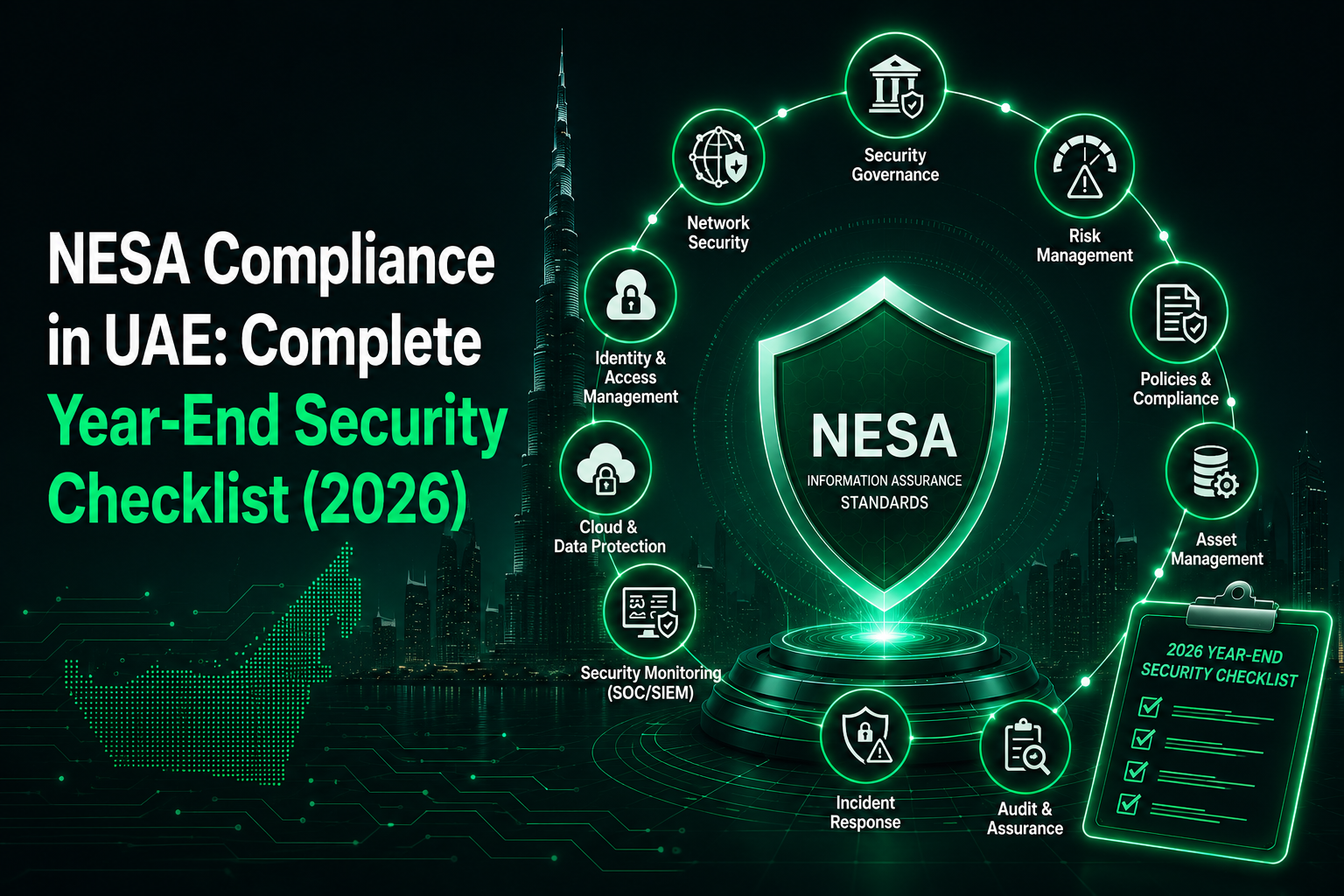
NESA compliance is a mandatory cybersecurity requirement for UAE government entities, semi-government organizations and Critical Information Infrastructure (CII) operators, built around the UAE Information Assurance (IA) Standards. Before year-end, organizations should review governance policies, risk management processes, identity and access controls, network security, data protection, continuous monitoring, incident response and employee awareness to ensure regulatory readiness. This guide explains the NESA compliance framework, key security controls, common implementation challenges and practical steps organizations can take to strengthen cyber resilience while preparing for audits and evolving regulatory requirements.
NESA compliance, originally established by the UAE federal government via Decree No. 3 of 2012 to set up the National Electronic Security Authority (NESA), is a legally binding cybersecurity mandate that enforces the UAE Information Assurance (IA) Standards. Officially introduced in June 2014 and significantly overhauled by the UAE Cybersecurity Council via the UAE IA Standard Version 2, the framework is currently governed under the Signals Intelligence Agency (SIA). It legally compels all UAE government entities, semi-government bodies and private Critical Information Infrastructure (CII) operators to move past basic perimeter defense and instead maintain a resilient, risk-based ecosystem.
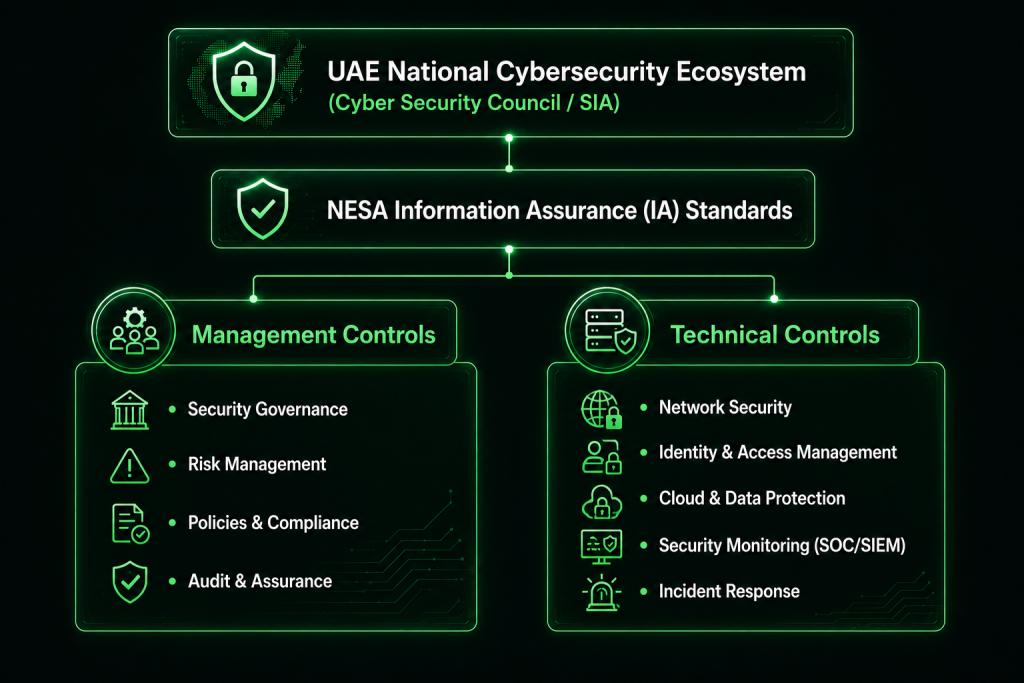
To achieve this, organizations must implement 188 security controls divided into management and technical domains, starting with a baseline of 35 mandatory Priority 1 (P1) controls. The high-level structure of the NESA Information Assurance framework is illustrated below.
Backed by stringent federal laws like Federal Decree-Law No. 34 of 2021 on Combating Rumours and Cybercrimes, failure to align triggers a strict four-tiered federal enforcement process, escalating from mandatory reporting up to national security intervention and exposes non-compliant entities to contract terminations, operational restrictions and regulatory fines reaching up to AED 5 million.
Year-end is the ideal time for UAE organizations to assess their cybersecurity posture, close security gaps and prepare for upcoming regulatory reviews. Many organizations use the final quarter to conduct security assessments, governance reviews and technology upgrades, making it the right opportunity to validate NESA compliance.
⦁ Improve Audit Readiness: Maintain accurate documentation and prepare for internal and external assessments.
⦁ Strengthen Security Controls: Address vulnerabilities, apply critical patches and remediate identified risks.
⦁ Reduce Regulatory Risk: Minimize the likelihood of compliance violations, operational disruptions and data breaches.
⦁ Enhance Executive Visibility: Provide leadership with a clear view of the organization’s cybersecurity posture.
⦁ Optimize IT Investments: Align cybersecurity initiatives with business priorities and upcoming budgets.
⦁ Strengthen Cyber Resilience: Improve readiness against evolving cyber threats through proactive risk management.
Organizations that delay compliance efforts often face rushed implementations, incomplete documentation, higher remediation costs and increased exposure to regulatory and operational risks.
Organizations should establish:
⦁ Clearly defined cybersecurity policies
⦁ Executive ownership of information security
⦁ Security governance committees
⦁ Documented roles and responsibilities
⦁ Regular policy reviews
This includes:
⦁ Asset identification
⦁ Threat analysis
⦁ Vulnerability assessments
⦁ Business impact analysis
⦁ Risk prioritization
⦁ Risk treatment plans
Organizations should implement:
⦁ Multi-factor authentication (MFA)
⦁ Role-based access control (RBAC)
⦁ Least privilege principles
⦁ Privileged Access Management (PAM)
⦁ Periodic access reviews
⦁ Secure identity lifecycle management
A mature monitoring strategy includes:
⦁ Security Operations Center (SOC)
⦁ Security Information and Event Management (SIEM)
⦁ Log monitoring
⦁ Threat intelligence
⦁ Incident detection
⦁ Continuous security monitoring
Critical controls include:
⦁ Endpoint Detection and Response (EDR)
⦁ Next-generation firewalls
⦁ Network segmentation
⦁ Secure VPN access
⦁ Email security
⦁ DNS protection
⦁ Secure configuration management
Organizations should ensure:
⦁ Data classification
⦁ Encryption at rest
⦁ Encryption in transit
⦁ Secure key management
⦁ Backup encryption
⦁ Data Loss Prevention (DLP)
Essential capabilities include:
⦁ Automated backups
⦁ Immutable backup copies
⦁ Disaster Recovery planning
⦁ Recovery testing
⦁ Recovery Time Objective (RTO)
⦁ Recovery Point Objective (RPO)
Every organization should maintain:
⦁ Incident response policies
⦁ Defined escalation procedures
⦁ Communication plans
⦁ Digital forensic readiness
⦁ Regular tabletop exercises
⦁ Post-incident review processes
Organizations should continuously perform:
⦁ Vulnerability scanning
⦁ Penetration testing
⦁ Patch management
⦁ Configuration reviews
⦁ Security validation
Employees should receive ongoing training covering:
⦁ Phishing awareness
⦁ Password hygiene
⦁ Social engineering
⦁ Secure remote working
⦁ Data handling practices
⦁ Incident reporting procedures
Many organizations assume NESA compliance is simply about passing an audit. In reality, the biggest hurdles are operational rather than technical.
⦁ 70% of UAE organizations manage more than 10 cybersecurity tools
As businesses grow, security solutions often accumulate from different vendors. The result is a fragmented security ecosystem where alerts are scattered, visibility is limited and incident response becomes slower instead of faster.
⦁ 90% of UAE companies report a cybersecurity talent shortage
Finding experienced cybersecurity professionals remains one of the region’s biggest challenges. Many organizations struggle to recruit or retain specialists capable of managing governance, risk assessments, incident response and compliance simultaneously.
⦁ Complex security environments increase breach costs
According to IBM’s 2025 Cost of a Data Breach Report, organizations in the Middle East experienced significantly higher breach costs when security environments became overly complex. Security staff shortages also increased the financial impact of cyber incidents.
⦁ Critical vulnerabilities often remain unpatched for weeks
Verizon’s 2026 Data Breach Investigations Report found that only 26% of critical vulnerabilities were fully remediated, with the median remediation time stretching to 43 days. Delayed patching remains one of the easiest attack paths for threat actors.
⦁ Compliance Is Becoming a Continuous Process
Modern cybersecurity frameworks such as NESA emphasize continuous monitoring, governance and risk management rather than one-time compliance exercises. Organizations relying on manual reporting, inconsistent documentation and periodic audits often find it difficult to maintain ongoing compliance as threats evolve.
Managed Security Services help organizations by providing:
⦁ 24×7 Security Operations Center (SOC)
⦁ Continuous threat monitoring
⦁ SIEM management
⦁ Vulnerability assessments
⦁ Incident response support
⦁ Compliance reporting
⦁ Risk monitoring
⦁ Security consulting
Preparing for NESA compliance requires more than implementing security controls, it demands continuous governance, monitoring and expert guidance. Global Infra helps UAE organizations strengthen their cybersecurity posture with managed security services, risk assessments, SOC, SIEM, cloud security and compliance consulting tailored to regulatory requirements. Connect with our experts to build a resilient, audit-ready security framework.